
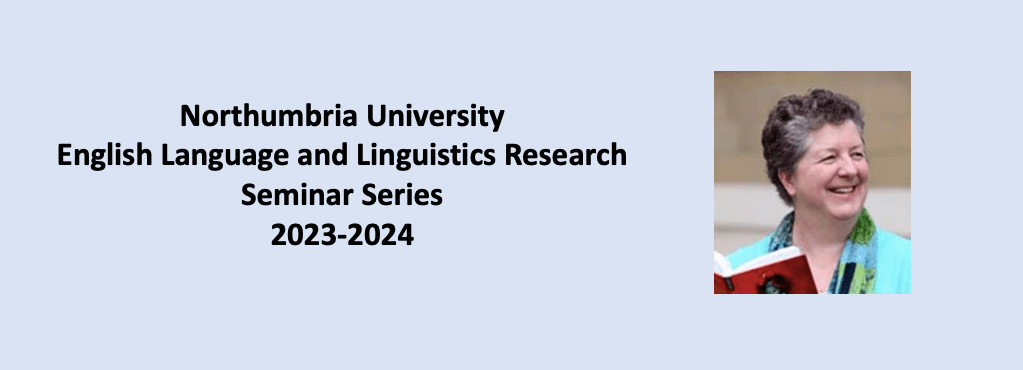
The next seminar of the Northumbria Institute of Humanities Research Seminar Series will take place on Wednesday 28th February 2024 at 2pm in Lipman Building, room 121, on our City Campus.
The speaker is Professor Lesley Jeffries from Lancaster University and her talk will be on ‘Poems, prose and politics: textual meaning in common‘ (there’s an abstract below).
The seminar will be delivered in a hybrid format so join us in person or online.
Speaker: Professor Lesley Jeffries, Lancaster University
Title: Poems, prose and politics: textual meaning in common
Time: 2pm, Wednesday 28 February 2024
Place: Lipman 121, City Campus, Northumbria University
Directions and campus map: https://www.northumbria.ac.uk/about-us/our-campuses/newcastle-city-campus
Email Billy Clark to join online: billy.clark@northumbria.ac.uk
Abstract:
Poems, prose and politics: textual meaning in common
Whilst stylistics has long had an overriding interest in the language of literature, and (critical) discourse analysis has tended to be more interested in everyday language, including the language of politics and news, there has been too little focus on what the processing of texts in these and other genres might have in common.
This talk will attempt to argue that despite their differences, texts of all genres and types have a level in common at which they (and their producers/recipients) work in similar ways. This idea proceeds from a scientific principle of economy (or Occam’s Razor) which suggests that the simplest explanation for a phenomenon should be the one adopted. Thus, the idea that we learn to engage with texts in the same way, whatever their genre, is more logical than the idea that we learn to engage differently with each different genre (always presuming we can identify them).
The consequence of this axiomatic starting point is that we need to identify how texts make meaning beyond the purely mundane lexico-grammatical but stopping short of the multiply-variable interpretations that individuals may derive from them. The answer, I would suggest, is a layer of textual meaning which is triggered by a set of textual-conceptual features (TCFs) originally forming the framework for Critical Stylistics (Jeffries 2010) and developed as a systematic approach to Critical Discourse Analysis. Having realised that this set of TCFs may produce meanings whose main appeal can be aesthetic rather than ideological, I tested them out on poetry (Jeffries 2022) and found they worked equally well as a way to explain where textual meaning hovers – between the grammar and lexis on the one hand and the fully contextual on the other.
The ideas behind this approach to textual meaning and the TCFs will be illustrated with examples from poetry, prose and politics.
Jeffries, L., (2010) Critical Stylistics. London: Palgrave
Jeffries, L., (2022) The Language of Contemporary Poetry. London: Palgrave
Lesley Jeffries
Hon Prof of Linguistics and English Language
Lancaster University
 Northumbria Englishes