We have a great line-up of research seminars for semester one of 2023-2024. Here is the lineup:
. . . We offer a combination of in-person and online seminars. In-person seminars will also be streamed via Teams unless otherwise stated.
. . . 18 October 2023 Dr Phillip Wallage (Northumbria University) How to say NO in early German and early English: changing ways to agree and disagree 12:00-13:00, Sandyford 301
. . .
1 November 2023 Dr Rachid Khoumikham (Northumbria University) Exploring career progression for female engineers: insights into the influence of English medium education (EME) on career progression in the UK and Palestine 12:00-13:00, Sandyford 301
. . . 22 November 2023 Prof. Louise Cummings (Hong Kong Polytechnic University) Cognitive-linguistic difficulties in adults with Long COVID 12:00-13:00, online via Teams
. . .
8 December 2023 Richie Greaves and Tony Evans (guest speakers and Hillsborough survivors) Hillsborough: the truth 15:00-16:00, Lipman 0001 Followed by a poster exhibition and presentations from EL6052 Forensic Linguistics at 16:00-17:00
. . . 13 December 2023 Dr Stefan Grondelaers (Radboud University Nijmegen) Title to be confirmed 12:00-13:00, online via Teams
. . .
All welcome. For further information, please contact Dr Mimi Huang, Research Group Lead and Postgraduate Research Lead for Language and Linguistics: mimi.huang@northumbria.ac.uk
As a second year Northumbria University student studying History and Politics, I applied for this Digital Archive Internship with Dr Helena Goodwyn in November 2022, and worked until March 2023. This internship was focused on digitising the manuscript of Joseph O. Baylen’s biography of W. T. Stead, a prominent nineteenth-century newspaper editor and a pioneer of modern journalism in England.
I was tasked with digitally transcribing the typewritten documents of Baylen’s work. The pages were scanned and uploaded online for me to then use Adobe Acrobat OCR technology to turn the PDF pages into Microsoft Word documents. This work included making sure that all the transcribed documents were coherent, correct, and set out in the right format, as the OCR technology meant that the documents were often not legible. As well as the transcriptions, I ensured that there were detailed, yet condensed, summaries of each page in order for everyone who will be working on the archive to be aware of the specifics and topics of each page and chapter. These tasks required being able to pay close attention to detail, to avoid mistranslations, along with being able to communicate effectively.
I was able to work closely with Dr Goodwyn. I was provided with a lot of help initially as I learned how to undertake the allocated tasks and how to do them effectively. This included many regular meetings with Dr Goodwyn, which turned to biweekly updates once we were both confident in my understanding and abilities. This internship allowed me to work in my own time to accommodate my schedule, as I was completing this alongside my studies as well as a part-time weekend job. Whenever issues arose, like illegible handwriting, it was very easy to contact Dr Goodwyn and gain her advice in the meantime.
I found this internship to be an amazing opportunity. It helped me to expand my skills in Microsoft programmes for the transcriptions of each document itself, along with allowing me to gain new skills in other programmes and technologies like Adobe Acrobat. Not only were my skills in technologies improved, but due to the nature of work I was completing, it helped me to expand my writing and communication skills, along with other professional skills like interviewing. Overall, it gave me insight into a discipline that I have never experienced before, and has helped me in deciding what area of work I may like to pursue outside of my university degree.
This internship has been a rewarding experience, as it has allowed me to gain knowledge of a new area of study that I have not previously encountered. It has allowed me to build and develop my CV by providing professional work experience in the field that I may be exploring in the future. It was a great experience that was workable alongside my other commitments. It has been an incredible opportunity to work with Helena and to expand my skillset in a professional capacity.
Unveiling History — A Journey as an Archive Project Intern
by Shruti Vasant Mayekar
Working as Dr Helena Goodwyn’s Intern for the Tyne Theatre Archiving Project was an extraordinary experience that allowed me to delve into the rich cultural heritage of Newcastle upon Tyne and took me on a journey through time. This blog post recounts my immersive journey into archiving the fascinating shows and performances that graced the historic Tyne Theatre and Opera House throughout the 19th century, preserving a remarkable slice of history.
Although I’m currently undertaking an MSc in Project Management at Northumbria, because of my deep passion for arts and history, the opportunity to contribute to preserving this rich past has been truly rewarding. The Archive Internship aims to digitize and organize the extensive collection of show programs through newspaper articles, journals, day bills, and other historical documents associated with the theatre’s 19th-century performances.
The process of archiving required attention to detail and involved carefully cataloging and digitizing information from each document to ensure its longevity and accessibility for future generations. By meticulously organizing the archive, we aim to create a digital database that will not only facilitate research but also preserve the theatre’s legacy. One of the many advantages of this internship is the valuable experience it offers in handling large-scale data management. Therefore, I have had the opportunity to navigate through extensive collections of historical documents, honing my skills in cataloging, digitization, and organizing vast amounts of data. This hands-on experience in data management has undoubtedly enhanced my abilities and prepared me for future endeavours in the field.
In addition to me, there were several volunteers working on this archival project, and we have ensured that the rich cultural heritage of the Tyne Theatre and Opera House will be accessible for generations to come. The digitized collection serves as a valuable resource for academic research, community engagement, and a testament to the enduring influence of the arts in Newcastle upon Tyne.
The time I’ve spent immersed in the show programs have painted vivid pictures for me of the era’s theatrical performances, featuring renowned actors, singers, and dancers who graced the stage. It evoked the excitement and anticipation that filled the air during those bygone years. As an international student, delving into the history and culture of the Tyne Theatre and Opera House has been a captivating experience. Being immersed in the vibrant theatre scene of the city has allowed me to gain a deeper understanding of the local arts and the city’s cultural fabric. It was a remarkable opportunity to witness firsthand the passion and enthusiasm that Newcastle residents hold for the performing arts.
My time as an Archive Intern working on the Tyne Theatre and Opera House archive has been a transformative experience. Throughout the course of the internship, I received interesting insights about the working of the theatre. Overall, this internship allowed me to combine my passion for history, project management, and love for the arts. I’m looking forward to the launch of the website, where this data will be showcased for all to explore and appreciate. Recognizing the immense value of this internship on my career path, I wholeheartedly encourage fellow Northumbria students to seize such opportunities whenever they arise. The experience gained and the skills acquired during this internship are invaluable assets that will undoubtedly shape and enhance our future professional journeys.
Our colleague Mimi Huang is the lead for this interactive workshop on the benefits to adults of reading and sharing stories with children. The event is free and open to all.
The event takes place on Saturday the 11th of November at Whitley Bay Library.
The Economic and Social Research Council (ESRC) is the funder for the festival, Mimi is the lead for this event and is working with two partners: Nicola Vernon (Humber Teaching NHS Foundation Trust) and Emmalene Charlton (Tyneside and Northumberland Mind)
Here is the event synopsis:
While much emphasis has been placed on the positive influence that reading has on children’s development and mental health, the contribution of such experiences to the mental health and wellbeing of the adults sharing the stories – such as parents, grandparents, and other caregivers – has been largely overlooked. This public engagement event, funded by the ESRC Social Science Festival, aims to shift the spotlight onto these shared-reading benefits for adults with childcare responsibilities.
Supported by experienced researchers, practitioners and experts at Northumbria University, Humber Teaching NHS Foundation Trust, and Tyneside and Northumberland Mind, the event will create an interactive platform for audiences to explore and share their personal experiences of reading with children, uncover hidden and unexpected benefits, and deepen their understanding of how reading with children can contribute to their mental health, personal development and lifelong wellbeing.
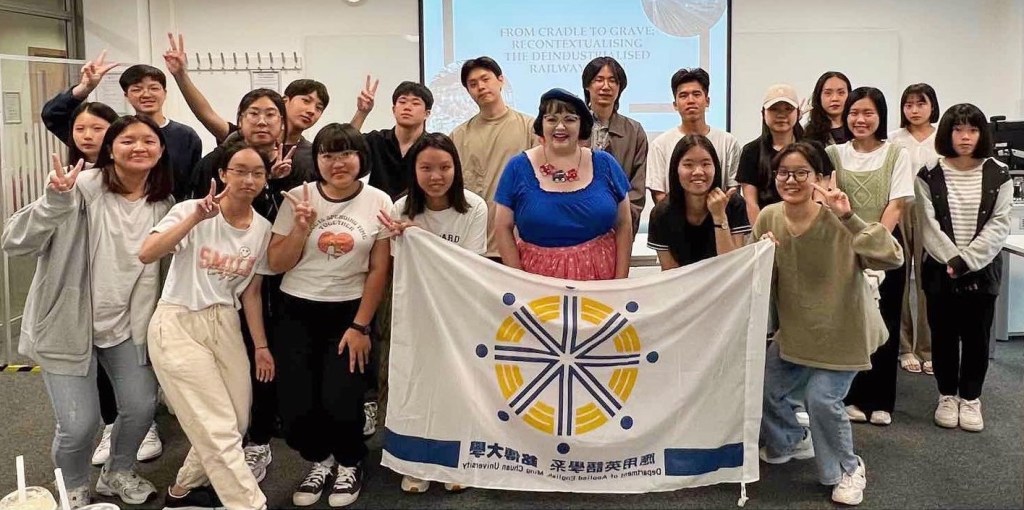
Laura Littlefair tells us about her experience teaching on this year’s Ming Chuan summer school
The first day of teaching is always a daunting one. Will my lecture be interesting? Have I got enough material to last the whole session? Will I be able to find the right room? Despite the myriad worries whizzing around my head, I really didn’t need to be concerned, as the students from Ming Chuan University in Taiwan put me at ease from the very beginning.
I was fortunate enough to lead two lectures on the Ming Chuan Humanities Cultural Programme, teaching students from the department of Applied English who had just completed their third year of study at the university. The partnership between Northumbria University and Ming Chuan University is a long-standing one, and for many years prior to the COVID-19 pandemic, Northumbria hosted their annual summer school. This was the first summer school since 2019, and being able to teach to a physical room of students was an incredibly engaging and enjoyable experience – a very different one to speaking to a swathe of black Zoom screens on a computer!
The first lecture I gave was based on my undergraduate dissertation, looking at how the railway poster as a genre in art and advertising explored the social and cultural impact of the railways in the 20th century. I taught the students about poster design in Belle Epoque France in the late 19th century that inspired many railway poster artists, through to pictorial railway posters in the 20th century and the big names in poster design during the ‘Golden Age’ from around 1923–1947. This was something of a whistle-stop tour of 20th century railway history, with plenty of eye-catching and vivid posters peppered throughout my lecture!
My second lecture centred around my current research, addressing deindustrialised communities that intersect with heritage institutions, and how local voices and groups are intrinsic to its history, heritage, and collective memory. The main case study is the North-Eastern town of Shildon, where my research will historicise engagement at three critical junctures in the town’s recent history: deindustrialisation in the 1980s; the opening of Locomotion railway museum in 2004; and the redefinition of this heritage’s value as part of the Stockton and Darlington Railway bicentenary (2025) and Locomotion’s Vision2025 redevelopment. As such, I took the students on a journey through early railway history, charting the course of the Stockton and Darlington Railway, and the importance of the Wagon Works in Shildon that began in 1826. Both lectures centred around my love of cultural and social railway history, providing the students with the opportunity to learn more about the railways in Britain, and their lasting influence upon art, advertising, museums, deindustrialisation, and nostalgia – a theme that runs through both research areas.
Before I began my PhD in October 2022, I was a museum professional, having been the Assistant Curator at Durham Castle Museum and the Museum of Archaeology at Durham University from 2019-2021. Prior to that, I completed my MA in Museum and Artefact Studies at Durham University, and over the course of my 2-year degree I worked part-time at both museums from 2017-1019. It should therefore come as no surprise that I adore museums, and the fascinating cultural experiences that can be gained from them. So, when the opportunity arose to accompany the students on a trip to Beamish: The Living Museum of the North, I hoped I would be able to share some knowledge about the rich history of the North East, and explore the new 1950s town with them.
When we first arrived, we took an open-top tram down into the 1900s Town, and then the students were able to explore the various areas of the museum at their own leisure over the course of the day. There’s a whole host of new attractions, such as the ongoing developments with the 1950s town, which now include Elizabeth’s Hairdressers, a Welfare Hall, Police Houses and Middleton’s Quality Fish and Chips – where several students and I enjoyed our lunch! I took a trip down the Mahogany Drift Mine in the 1900s Pit Village and Colliery with some of the students and staff, sporting some delightful bright green hard hats, which matched my beret of choice on the day too. I also travelled on the Pockerley Waggonway on a replica of a very early steam locomotive, Puffing Billy, which was obviously right up my street. Thankfully, it was a dry and sunny day, meaning I was able to enjoy the scenery of 1820s Pockerley as we chugged and jostled along the track, in a fourth class open-top carriage. Like many of the students, I rounded off the day with a visit to the gift shop, filled with an abundance of vintage-themed goodies and Beamish-branded items, including Christmas baubles, a tram driver teddy, and even Beamish monopoly!
The small part I played on the Ming Chuan Humanities Cultural Programme this summer has given me so much more than just a day out to a museum, or the opportunity to talk for 4 hours about railways. It gave me the confidence that I can teach students about my research, and that this is something I could actually do as a career after my PhD. It allowed me to experiment with different ways of presenting information, through posters, photographs, text and maps, seeing what worked well, and what wasn’t as engaging for students. At the end of my day of teaching, the students were extremely generous, and gave me a whole selection of gifts from the university to thank me for my lectures. I expected nothing from the students – other than the hope that they would enjoy my sessions – so this came as a genuine surprise, and one that will continue to remind me of my first teaching sessions and where it all began for many years to come.