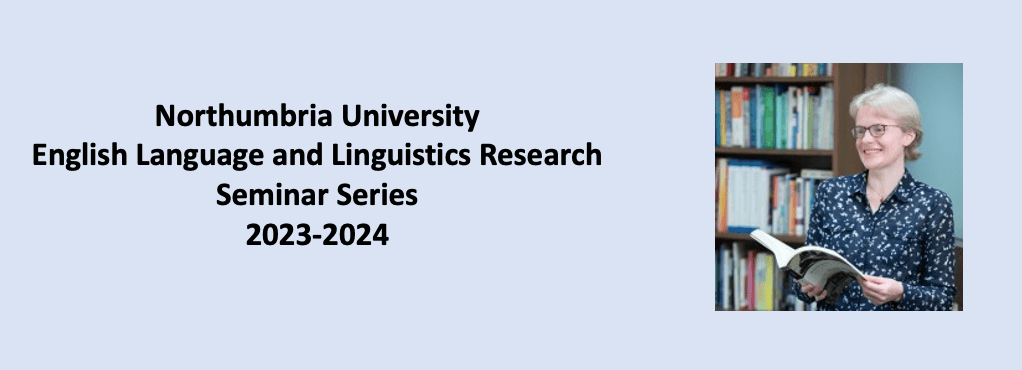
The next speaker in this semester’s linguistics research seminar series is Professor Louise Cummings who will be talking on the cognitive-linguistic effects of long COVID.
There’s more information below and information on all talks here:
Speaker: Professor Louise Cummings (The Hong Kong Polytechnic University)
Time: 12:00-13:00
Date: Wednesday 22nd November
Mode of delivery: Online via Teams
Seminar title: Cognitive-linguistic difficulties in adults with Long COVID
Abstract:
The COVID-19 pandemic has resulted in a large number of people who have not made a good recovery from their COVID infections. For these individuals, physical and cognitive symptoms can persist for months and even years after the initial illness. Cognitive-linguistic difficulties (so-called “brain fog”) are a prominent feature of the Long COVID syndrome, and are known to persist in sufferers long after physical symptoms have resolved. This talk examines the nature of these difficulties by examining language data from 92 adults with the Long COVID syndrome (Cummings, 2023). These adults reported significant problems with cognition and language following acute COVID illness, with many unable to return to work. This talk explores their self-reported cognitive-linguistic difficulties and relates them to problems with verbal recall, verbal fluency, and informativeness during discourse production.
Cummings, L. (ed.) (2023) COVID-19 and Speech-Language Pathology, New York: Routledge.
All welcome. For further information, please contact Dr Mimi Huang, Research Group Lead and Postgraduate Research Lead for Language and Linguistics: mimi.huang@northumbria.ac.uk
As part of a £100,000 British Council grant (Principal Investigator Bill Guariento), Northumbria University welcomed students and academics from the Islamic University of Gaza this week. After 2 years of online work, we now have face-to-face contact.