Fiona Shaw: ‘Outwalkers’, ‘Tell It To The Bees’ and Yaddo


fionashaw

We are delighted that our colleague Fiona Shaw has been nominated for 2019 CILIP Carnegie Medal for her novel Outwalkers  You can find the full list of nominations here

To add to this, Fiona has also been awarded a month’s residency at the prestigious Yaddo artists’ retreat, whose prior residents have included James Baldwin, Langston Hughes, Katherine Anne Porter and Jeffrey Eugenideshttps://www.yaddo.org/about/history/

tellittothebees

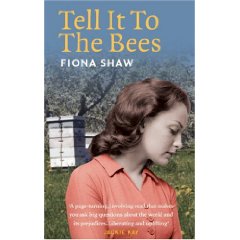
Meanwhile, the film version of Fiona’s novel Tell It To The Bees has been appearing at festivals, including at Cannes and the Toronto film festival

We are very happy about this well-deserved recognition of Fiona’s work

Orthography, speech production and perception

Our first Linguistics Research seminar this semester will focus on links between how we write (orthography) and how we perceive and produce speech (phonology).

It will be a fascinating talk so do come along if you are in or near Newcastle and you can make it.

The speaker is Dr. Rebecca Ishaku Musa from Newcastle University.

The talk will take place at 2-3pm in the Lipman Building Room 121

There is a campus map and directions to the campus here:

https://www.northumbria.ac.uk/contact-us/

Here is further information:

The effect of L2 English orthographic representations on L1 Tera speakers’ production and perception

Dr Rebecca Ishaku Musa

Abstract

Studies in L2 acquisition of phonology and orthographic input have provided evidence about L2 learners’ phonological development due to orthographic input (e.g. Young-Scholten 2002 and Young-Scholten and Langer 2015). Also, the effects of grapheme-phoneme correspondences leading to non-target like productions (e.g. Rafat 2011 & 2016); and the effects of orthographic representation on pronunciation (e.g. Bassetti 2008 and Bassetti and Atkinson 2015). Studies have also looked at the effect of orthographic exposure leading to epenthesis to resolve complex clusters (e.g. Young-Scholten, Akita and Cross 1999). In this regard, a study was conducted involving L1 Tera (bilingual speakers of Tera/Hausa in Nigeria) learners of L2 English in an experimental study which looked at whether providing L2 English orthographic input would affect the learners underlying representations and in turn their productions.

Data was collected among 73 Tera speaking secondary school students in pre-test and post-test in picture-naming, dictation, ABX epenthesis and reading tasks. Qualitative analysis was conducted using linear phonological operations and rules based on six error categories as follows: vowel epenthesis, consonant cluster reduction, phone substitution, metathesis, loan-word transfer, and orthographic-based errors.

The results revealed transfer from the learners L1 structures which were less complex than the L2 structures resulting in epenthesis of vowels [u] [o] [ɪ] to resolve complex consonat clusters not permitted in their L1, e.g. ’bench’ /benʧ/ → [benʧɪ]; or deletion of segments e.g. ‘lamps’ /lamps/ → [lams]. Also, there was increased effects of orthographic forms due to the complexity of the L2 English grapheme-phoneme correspondences resulting in what Bassetti and Atkinson (2015) refer to as ‘orthography-induced-epenthesis’ e.g. ‘knife’ /naɪf/ → [kinaɪf]. Also metathesis occurred, which is the reordering of words in order to resolve clusters that constitute L1 specific constraints, e.g. ‘desk’ /desk/ → [deks].


The language of the lake

alexbellosUrosimage

Today’s puzzle from Alex Bellos in The Guardian requires a range of skills which can be developed in English Language programmes (and in other subjects, including maths).

As Alex says, today’s puzzle is ‘hard, but not impossible’. He also suggests that working on puzzles like this can help you develop the skills needed to find a job with technology firms such as google. That suggestions is based on this article by Sam Gibbs in which he reports thoughts from google’s head of search, Ben Gomes.

Alex’s puzzle is one that has been used in the North American Computational Linguistics Olympiad, one of several linguistics olympiads held around the world which then select teams to enter the International Linguistics Olympiad. The UK Linguistics Olympiad has been  very successful with lots of school students taking part each year.

You have until 5pm UK time today to solve it before Alex reveals the answer . . .


EU-Speak Event 20-21 July: New ideas on adult language learning

EU-Speak July 2018

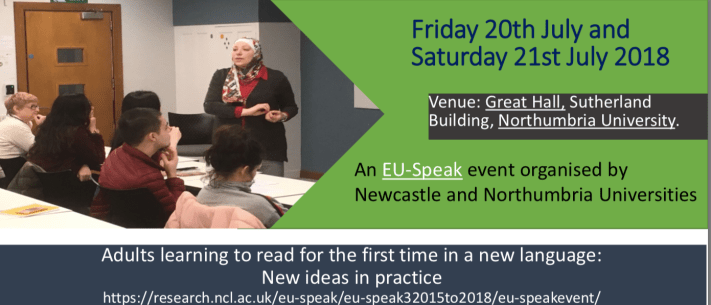
We are very much looking forward to hosting an important event at Northumbria on the 20th and 21st of July, in collaboration with colleagues at Newcastle University and a number of international partners.

The event, organised by the Eu-Speak Project, presents and explores new ideas for teaching adults to learn to read in a new language for the first time.

The EU-Speak Project is an eight-year project working to make a difference in the educational outcomes for immigrants with little or no education. It involves a number of international partners, including colleagues here at Northumbria and at Newcastle University. The project has already been very successful, developing a range of important findings and useful materials, and it continues to grow and to make significant progress, You can read about the project here

The event will include a wide range of workshops and hands-on activities.

Here are links where you can find out more and book a place:

EU-Speak event website

EU-Speak event flyer and programme

Registration form

There is a fee to attend but bursaries are available (see registration form for details)

If you have any queries about the event, please contact Rola Naeb


Lisa Matthews wins Welshpool poetry competition

author-photo-lisa-matthews

Final-year PhD candidate/PGR researcher Lisa Matthews has been announced as the winner of the 2018 Welshpool Poetry Festival competition. The event took place over the weekend of 8/9 June, and festival judge Andrew McMillan said of Lisa’s prize-winning entry:

‘Gaze’ is a poem that I’m still working out each time I read it; the definite nature of the title is misleading, it’s a kaleidoscopic, shifting poem which keeps returning the reader to a place of uncertainty. Each time we return to it things appear slightly clearer, we see a little more, but then the ground moves beneath us again. It’s as if we are looking at the world through a diamond.

Lisa’s doctoral research at Northumbria explores the role of prose poem sequences in transforming life experience into poetry; and ‘Gaze’ is a prose poem triptych taken from an emergent practice strand.

The news is timely as Lisa’s fourth collection, Callisto, has just been released by Scotland-based publisher Red Squirrel Press. Callisto is made entirely of interconnected prose poem sequences and Gillian Allnutt has described Callisto as a “courageous book, clear-eyed, unflinching”. For more details about Lisa and her writing/research visited her academic profile and writer’s portfolio.

To read Lisa’s prize-wining poem ‘Gaze’ visit the Welshpool website, where you can also view Andrew McMillan’s full statement about the selected poems, and get more information about this annual festival.