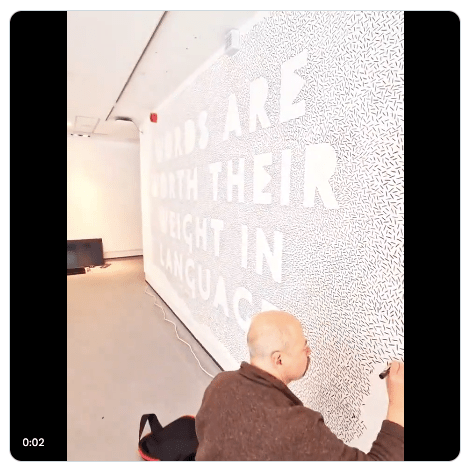
Pragmatic Stylistics and Creative Practice: A workshop led by Billy Clark and Tony Williams
Wednesday 8 May. 2:45 – 3:45
You are invited to participate in this workshop developed by Billy Clark and Tony Williams in response to the call for expressions of interest and the current Gallery North exhibition programme, WHAT ARE WORDS WORTH?
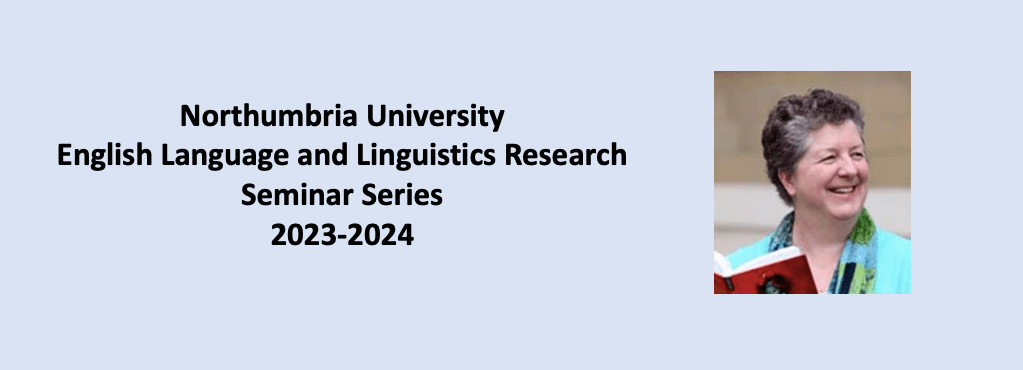
The next seminar of the Northumbria Institute of Humanities Research Seminar Series will take place on Wednesday 28th February 2024 at 2pm in Lipman Building, room 121, on our City Campus.
The speaker is Professor Lesley Jeffries from Lancaster University and her talk will be on ‘Poems, prose and politics: textual meaning in common‘ (there’s an abstract below).
The seminar will be delivered in a hybrid format so join us in person or online.
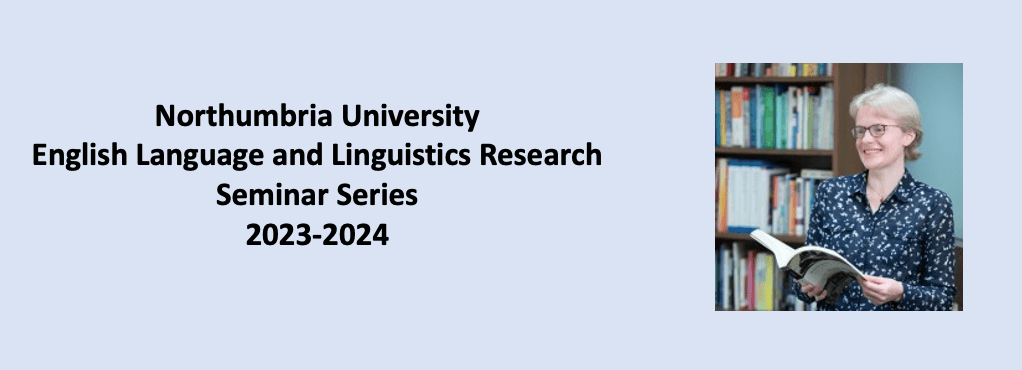
The next speaker in this semester’s linguistics research seminar series is Professor Louise Cummings who will be talking on the cognitive-linguistic effects of long COVID.
There’s more information below and information on all talks here:
Speaker: Professor Louise Cummings (The Hong Kong Polytechnic University)
Time: 12:00-13:00
Date: Wednesday 22nd November
Mode of delivery: Online via Teams
Seminar title: Cognitive-linguistic difficulties in adults with Long COVID
Abstract:
The COVID-19 pandemic has resulted in a large number of people who have not made a good recovery from their COVID infections. For these individuals, physical and cognitive symptoms can persist for months and even years after the initial illness. Cognitive-linguistic difficulties (so-called “brain fog”) are a prominent feature of the Long COVID syndrome, and are known to persist in sufferers long after physical symptoms have resolved. This talk examines the nature of these difficulties by examining language data from 92 adults with the Long COVID syndrome (Cummings, 2023). These adults reported significant problems with cognition and language following acute COVID illness, with many unable to return to work. This talk explores their self-reported cognitive-linguistic difficulties and relates them to problems with verbal recall, verbal fluency, and informativeness during discourse production.
Cummings, L. (ed.) (2023) COVID-19 and Speech-Language Pathology, New York: Routledge.
All welcome. For further information, please contact Dr Mimi Huang, Research Group Lead and Postgraduate Research Lead for Language and Linguistics: mimi.huang@northumbria.ac.uk
We have a great line-up of research seminars for semester one of 2023-2024. Here is the lineup:
. . . We offer a combination of in-person and online seminars. In-person seminars will also be streamed via Teams unless otherwise stated.
. . . 18 October 2023 Dr Phillip Wallage (Northumbria University) How to say NO in early German and early English: changing ways to agree and disagree 12:00-13:00, Sandyford 301
. . .
1 November 2023 Dr Rachid Khoumikham (Northumbria University) Exploring career progression for female engineers: insights into the influence of English medium education (EME) on career progression in the UK and Palestine 12:00-13:00, Sandyford 301
. . . 22 November 2023 Prof. Louise Cummings (Hong Kong Polytechnic University) Cognitive-linguistic difficulties in adults with Long COVID 12:00-13:00, online via Teams
. . .
8 December 2023 Richie Greaves and Tony Evans (guest speakers and Hillsborough survivors) Hillsborough: the truth 15:00-16:00, Lipman 0001 Followed by a poster exhibition and presentations from EL6052 Forensic Linguistics at 16:00-17:00
. . . 13 December 2023 Dr Stefan Grondelaers (Radboud University Nijmegen) Title to be confirmed 12:00-13:00, online via Teams
. . .
All welcome. For further information, please contact Dr Mimi Huang, Research Group Lead and Postgraduate Research Lead for Language and Linguistics: mimi.huang@northumbria.ac.uk
As a second year Northumbria University student studying History and Politics, I applied for this Digital Archive Internship with Dr Helena Goodwyn in November 2022, and worked until March 2023. This internship was focused on digitising the manuscript of Joseph O. Baylen’s biography of W. T. Stead, a prominent nineteenth-century newspaper editor and a pioneer of modern journalism in England.
I was tasked with digitally transcribing the typewritten documents of Baylen’s work. The pages were scanned and uploaded online for me to then use Adobe Acrobat OCR technology to turn the PDF pages into Microsoft Word documents. This work included making sure that all the transcribed documents were coherent, correct, and set out in the right format, as the OCR technology meant that the documents were often not legible. As well as the transcriptions, I ensured that there were detailed, yet condensed, summaries of each page in order for everyone who will be working on the archive to be aware of the specifics and topics of each page and chapter. These tasks required being able to pay close attention to detail, to avoid mistranslations, along with being able to communicate effectively.
I was able to work closely with Dr Goodwyn. I was provided with a lot of help initially as I learned how to undertake the allocated tasks and how to do them effectively. This included many regular meetings with Dr Goodwyn, which turned to biweekly updates once we were both confident in my understanding and abilities. This internship allowed me to work in my own time to accommodate my schedule, as I was completing this alongside my studies as well as a part-time weekend job. Whenever issues arose, like illegible handwriting, it was very easy to contact Dr Goodwyn and gain her advice in the meantime.
I found this internship to be an amazing opportunity. It helped me to expand my skills in Microsoft programmes for the transcriptions of each document itself, along with allowing me to gain new skills in other programmes and technologies like Adobe Acrobat. Not only were my skills in technologies improved, but due to the nature of work I was completing, it helped me to expand my writing and communication skills, along with other professional skills like interviewing. Overall, it gave me insight into a discipline that I have never experienced before, and has helped me in deciding what area of work I may like to pursue outside of my university degree.
This internship has been a rewarding experience, as it has allowed me to gain knowledge of a new area of study that I have not previously encountered. It has allowed me to build and develop my CV by providing professional work experience in the field that I may be exploring in the future. It was a great experience that was workable alongside my other commitments. It has been an incredible opportunity to work with Helena and to expand my skillset in a professional capacity.



 Northumbria Englishes