

Meet A Linguist
A free online event for A Level students (of any subject)
Friday 21 January 2022 at 1-1.30 pm or 5-5.30pm (we are offering this session twice)
Continue reading “Meet A Linguist”Meet A Linguist
A free online event for A Level students (of any subject)
Friday 21 January 2022 at 1-1.30 pm or 5-5.30pm (we are offering this session twice)
Continue reading “Meet A Linguist”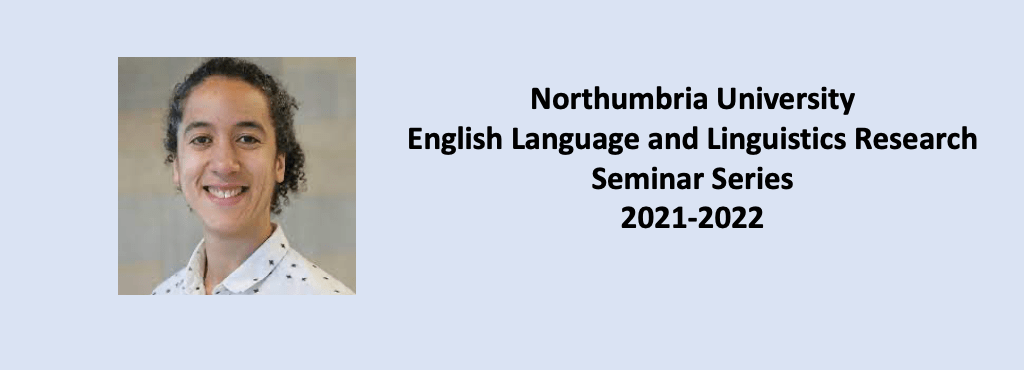
The first speaker in our English Language and Linguistics research seminar series this semester is Hannah Gibson from the University of Essex.
The talk takes place online at 2.30-3.30pm UK time on Thursday 20th of January. Please email me for a link: Billy Clark, billy.clark@northumbria.ac.uk
Continue reading “Dynamic Syntax”
The next speaker in our English Language and Linguistics research seminar series is Mel Evans from the University of Leeds.
The talk takes place online at 12-1pm UK time on Wednesday 8th of December. Please email me for a link: Billy Clark, billy.clark@northumbria.ac.uk
Continue reading “When Oroonoko is not enough?”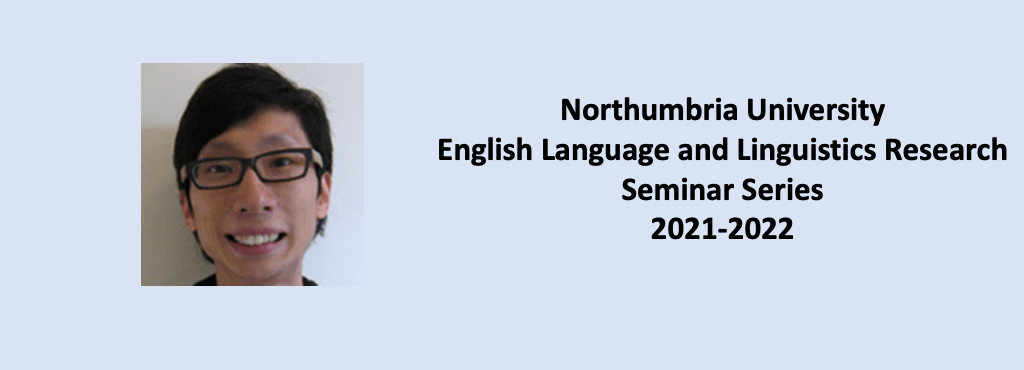
The next speaker in our research seminar series this semester is our colleague Alex Ho-Cheong Leung. Alex is a Senior Lecturer in Linguistics at Northumbria.
The talk takes place in person at 11am on Wednesday 24th November 2021 in room 205 in the Squires Annexe building.
The talk is titled ‘Perceptual difficulties with L2 English clusters and short vowels: Implications for pronunciation teaching and learning‘. There is an abstract below.
You can find directions to the campus and a campus map here:
https://www.northumbria.ac.uk/about-us/our-campuses/newcastle-city-campus/
We will also be streaming the talk for people who would like to attend that way. For the link to join, please email Billy Clark: billy.clark@northumbria.ac.uk
Abstract
Research has demonstrated that second/ foreign language (L2/FL) learners often struggle with the production of consonant clusters. It is common for learners to employ various simplification strategies including, deletion, substitution, and epenthesis in the production of clusters that are either absent or more complex than those in their first language. For example, it has been reported that some Spanish learners of L2 English epenthesise (i.e. supply extra materials) to break up clusters resulting in “espain” while attempting to pronounce “Spain”. It is worth asking whether non-target like production of clusters such as the above can be attributed to difficulties in perception. In fact, L2 speech research have started to explore the notion of “perceptual illusion” where participants report perceiving “phantom” elements that are not actually present in the speech stream.
This presentation reports on a study that investigated English consonant clusters and short, unstressed vowel perception of 70 Arabic-, Mandarin-, Spanish-speaking foreign language learners and 19 native English speakers. Results from an AX-discrimination task show that participants misperceive stimuli containing consonant clusters and counterparts where clusters are broken up by epenthetic/prothetic elements. In light of these findings, we encourage a reconsideration of the balance between focusing on production and perception in pronunciation instructions. Despite advances in L2 speech research which demonstrates the close link between production and perception, materials written for popular consumption continue to rely heavily on “traditional approaches” which place a strong emphasis on “accurate production” at the expense of the perception domain.
Keywords: consonant clusters; illusory vowels and epenthesis; perceptual illusion; second language perception; short vowels and schwa
Content warning: this talk will deal with difficult topics which some audience members may find disturbing.
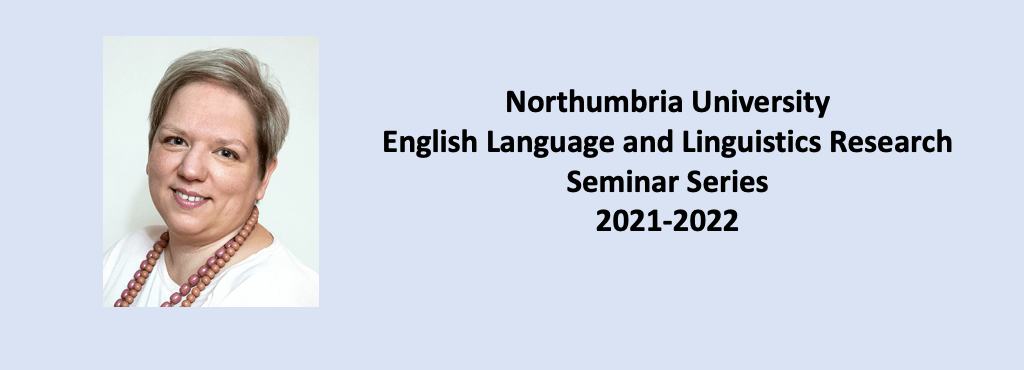
We are delighted to welcome Veronika Koller, from Lancaster University as the next speaker in our research seminar series this semester.
The talk takes place online at 12noon UK time on Wednesday the 17th of November.
The talk is open to all and will be delivered via Teams. Please email Billy clark for the link: billy.clark@northumbria.ac.uk
The title of Veronika’s talk is:
‘Introducing Mantrap: Misogyny and the Red Pill‘
The abstract is below.
The talk is open to all. For any queries, please email Billy Clark: billy.clark@northumbria.ac.uk
The full programme for this semester is at: https://northumbriaenglish.org/northumbria-linguistics-seminars-2021-2022/
. . .
Abstract:
Introducing Mantrap: Misogyny and the Red Pill
Veronika Koller (with Jess Aiston, Alexandra Krendel and Mark McGlashan)
In this talk, I will introduce a research project that focuses on language use in the so-called manosphere. The manosphere can be described as a loose online network of websites and discussion forums dedicated to specific issues relating to men and masculinity, such as techniques for the seduction of women, male separatism, men’s rights activism, and ‘involuntary celibacy’. Consistent across many of these sites and forums is the legitimation of misogyny through discussion of ‘red pill philosophy’, which disavows feminism and gender equality. The Mantrap project examines language use within and between manosphere communities and considers how the popularisation and normalisation of misogynistic discourse especially online may have profound social effects on beliefs, values and social behaviours.
I will introduce the members of the project team, highlighting their contributions and elaborating on the special aspects of manopshere discourse that they work on. This will be followed by a review of publications that have resulted from our collaborative work, alongside other previous studies that inform our research. In short, this part of my talk will summarise what we know about the language use by different groups within the manosphere so far.
The team works with a range of academic and non-academic research partners to develop and disseminate tools and strategies for countering the social harms resulting from the normalisation of misogynist discourse and practices, especially via mainstream online media. Accordingly, the final part of my talk will focus on collaborations between the Mantrap team and individuals and organisations in academia and beyond.
 Northumbria Englishes