The Benefits of Reading with Children

There are lots of exciting events in this year’s Festival of Social Science

Our colleague Mimi Huang is the lead for this interactive workshop on the benefits to adults of reading and sharing stories with children. The event is free and open to all.

The event takes place on Saturday the 11th of November at Whitley Bay Library.

The Economic and Social Research Council (ESRC) is the funder for the festival, Mimi is the lead for this event and is working with two partners: Nicola Vernon (Humber Teaching NHS Foundation Trust) and Emmalene Charlton (Tyneside and Northumberland Mind) 

Here is the event synopsis: 

While much emphasis has been placed on the positive influence that reading has on children’s development and mental health, the contribution of such experiences to the mental health and wellbeing of the adults sharing the stories – such as parents, grandparents, and other caregivers – has been largely overlooked. This public engagement event, funded by the ESRC Social Science Festival, aims to shift the spotlight onto these shared-reading benefits for adults with childcare responsibilities.

Supported by experienced researchers, practitioners and experts at Northumbria University, Humber Teaching NHS Foundation Trust, and Tyneside and Northumberland Mind, the event will create an interactive platform for audiences to explore and share their personal experiences of reading with children, uncover hidden and unexpected benefits, and deepen their understanding of how reading with children can contribute to their mental health, personal development and lifelong wellbeing.

The event webpage is here:

https://festivalofsocialscience.com/events/beyond-bedtime-the-hidden-joy-and-wellness-in-adults-reading-with-children/

And you can find out more about the festival here:

https://www.northumbria.ac.uk/about-us/news-events/news/social-sciences-festival/

Ming Chuan Summer School 2023

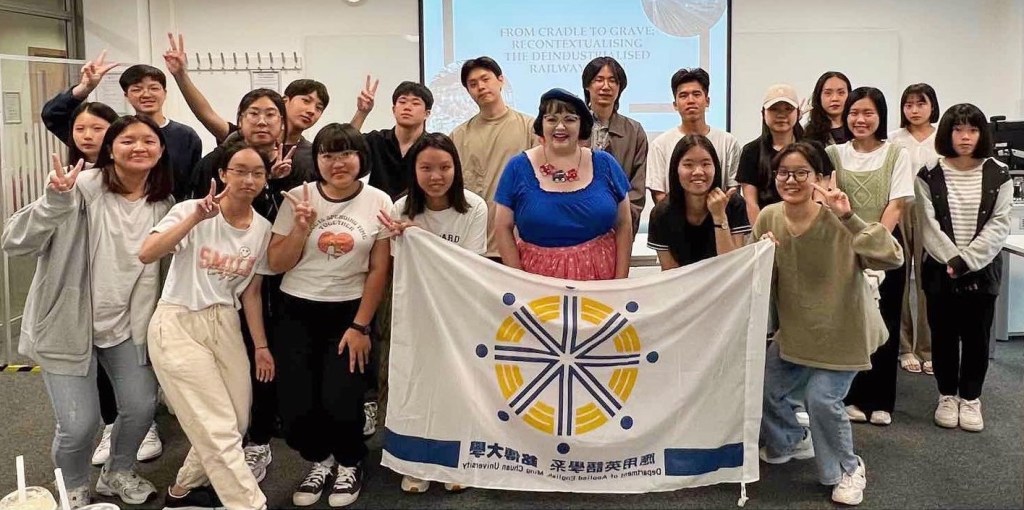
Laura Littlefair tells us about her experience teaching on this year’s Ming Chuan summer school

The first day of teaching is always a daunting one. Will my lecture be interesting? Have I got enough material to last the whole session? Will I be able to find the right room? Despite the myriad worries whizzing around my head, I really didn’t need to be concerned, as the students from Ming Chuan University in Taiwan put me at ease from the very beginning.

I was fortunate enough to lead two lectures on the Ming Chuan Humanities Cultural Programme, teaching students from the department of Applied English who had just completed their third year of study at the university. The partnership between Northumbria University and Ming Chuan University is a long-standing one, and for many years prior to the COVID-19 pandemic, Northumbria hosted their annual summer school. This was the first summer school since 2019, and being able to teach to a physical room of students was an incredibly engaging and enjoyable experience – a very different one to speaking to a swathe of black Zoom screens on a computer!

The first lecture I gave was based on my undergraduate dissertation, looking at how the railway poster as a genre in art and advertising explored the social and cultural impact of the railways in the 20th century. I taught the students about poster design in Belle Epoque France in the late 19th century that inspired many railway poster artists, through to pictorial railway posters in the 20th century and the big names in poster design during the ‘Golden Age’ from around 1923–1947. This was something of a whistle-stop tour of 20th century railway history, with plenty of eye-catching and vivid posters peppered throughout my lecture!

My second lecture centred around my current research, addressing deindustrialised communities that intersect with heritage institutions, and how local voices and groups are intrinsic to its history, heritage, and collective memory. The main case study is the North-Eastern town of Shildon, where my research will historicise engagement at three critical junctures in the town’s recent history: deindustrialisation in the 1980s; the opening of Locomotion railway museum in 2004; and the redefinition of this heritage’s value as part of the Stockton and Darlington Railway bicentenary (2025) and Locomotion’s Vision2025 redevelopment. As such, I took the students on a journey through early railway history, charting the course of the Stockton and Darlington Railway, and the importance of the Wagon Works in Shildon that began in 1826. Both lectures centred around my love of cultural and social railway history, providing the students with the opportunity to learn more about the railways in Britain, and their lasting influence upon art, advertising, museums, deindustrialisation, and nostalgia – a theme that runs through both research areas.

Before I began my PhD in October 2022, I was a museum professional, having been the Assistant Curator at Durham Castle Museum and the Museum of Archaeology at Durham University from 2019-2021. Prior to that, I completed my MA in Museum and Artefact Studies at Durham University, and over the course of my 2-year degree I worked part-time at both museums from 2017-1019. It should therefore come as no surprise that I adore museums, and the fascinating cultural experiences that can be gained from them. So, when the opportunity arose to accompany the students on a trip to Beamish: The Living Museum of the North, I hoped I would be able to share some knowledge about the rich history of the North East, and explore the new 1950s town with them.

When we first arrived, we took an open-top tram down into the 1900s Town, and then the students were able to explore the various areas of the museum at their own leisure over the course of the day. There’s a whole host of new attractions, such as the ongoing developments with the 1950s town, which now include Elizabeth’s Hairdressers, a Welfare Hall, Police Houses and Middleton’s Quality Fish and Chips – where several students and I enjoyed our lunch! I took a trip down the Mahogany Drift Mine in the 1900s Pit Village and Colliery with some of the students and staff, sporting some delightful bright green hard hats, which matched my beret of choice on the day too. I also travelled on the Pockerley Waggonway on a replica of a very early steam locomotive, Puffing Billy, which was obviously right up my street. Thankfully, it was a dry and sunny day, meaning I was able to enjoy the scenery of 1820s Pockerley as we chugged and jostled along the track, in a fourth class open-top carriage. Like many of the students, I rounded off the day with a visit to the gift shop, filled with an abundance of vintage-themed goodies and Beamish-branded items, including Christmas baubles, a tram driver teddy, and even Beamish monopoly!

The small part I played on the Ming Chuan Humanities Cultural Programme this summer has given me so much more than just a day out to a museum, or the opportunity to talk for 4 hours about railways. It gave me the confidence that I can teach students about my research, and that this is something I could actually do as a career after my PhD. It allowed me to experiment with different ways of presenting information, through posters, photographs, text and maps, seeing what worked well, and what wasn’t as engaging for students. At the end of my day of teaching, the students were extremely generous, and gave me a whole selection of gifts from the university to thank me for my lectures. I expected nothing from the students – other than the hope that they would enjoy my sessions – so this came as a genuine surprise, and one that will continue to remind me of my first teaching sessions and where it all began for many years to come.

Aphra Behn Internship

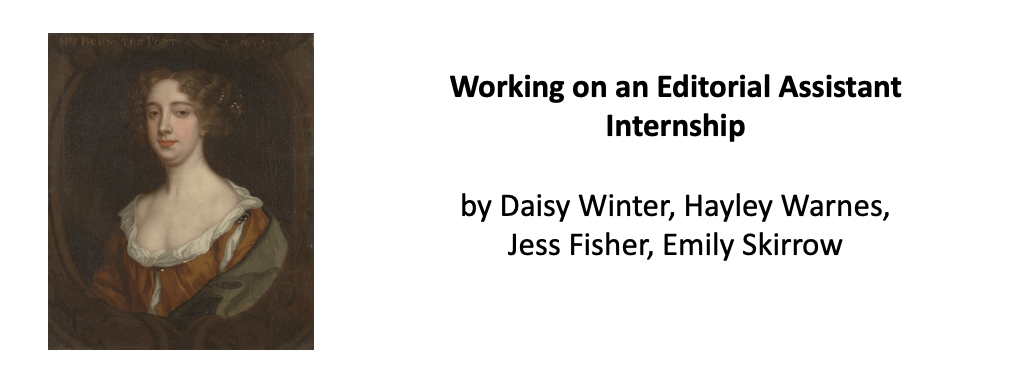
Earlier this summer, three interns from the BA English programmes, Emily, Jess, and Hayley, were recruited to work on a forthcoming edition of the writings of Aphra Behn (1640-1689), England’s first professional woman poet. The Behn edition is being prepared by Claudine van Hensbergen, Associate Professor of Eighteenth-Century Literature, and is part of her ongoing work on this important author. It will be published by Oxford University Press, as part of their 21st-Century Oxford Authors series.

The interns were tasked with transcribing text from early copies of Behn’s writings. Transcription is a crucial early step in the process of producing an edition of an author’s works. The goal was to provide a semi-diplomatic transcription, where a transcriber makes small adjustments to make the text more readable (unlike a diplomatic transcription, where the transcriber represents the text exactly with no adjustments). The interns worked from electronic scans of Behn’s works to produce the first ‘layer’ of transcription. This action required close attention to detail: as Behn’s works were originally printed in the late seventeenth century, several of the scans of the early printed texts were partially damaged or contained subtle typographical errors.

For Emily, the task of transcribing Behn’s works was initially daunting: “The transcription process was different to anything I had ever done before” but after she had familiarised herself with the language Behn used, her confidence grew.

Jess also found the transcription process challenging at the start. “A challenge I initially faced was familiarising myself with the language and the spellings of certain words in the text”, Jess explained. However, Jess found that the more she worked on the text the easier the process became.

The interns were mentored by PhD student Daisy Winter, who has also been working on the edition’s transcriptions and is in the final stages of writing a thesis exploring early women’s memoirs of the late seventeenth and early eighteenth centuries. Daisy met with the group regularly throughout the summer over Microsoft Teams to discuss the interns’ progress and support the development of their editorial skills. Indeed, the interns completed most of their work remotely over the course of the summer.

Hayley really enjoyed working remotely and appreciated Daisy’s support during the weekly meetings. “I think the meetings with Daisy were really helpful, as she helped to clarify any issues that we were all having, and it was just nice to speak to people and catch up”. Emily enjoyed working remotely as it allowed her to manage her hours around her other commitments: “It was flexible and very effective”.

At the beginning of the semester the interns were also able to meet in person with Claudine and Daisy to reflect on their experience and discuss the benefits of completing an internship alongside their studies. Jess particularly appreciated the opportunity to develop her knowledge of Behn’s work. “As I am now taking the ‘Women in Writing: Aphra Behn’ module in my third year, this opportunity has really helped shape my knowledge of Behn prior to joining the module.”

Overall, Emily, Jess, and Hayley thoroughly enjoyed the internship and recommend the experience to their fellow students. For Jess, the internship was “a fantastic opportunity” which “has supplied me with new skills that I wouldn’t have gained otherwise”.  Emily thinks that the internship enables students to develop skills in “problem solving and working as a team” which will benefit her future career. Hayley agreed that the completion of an internship “looks great on your CV”, and felt the experience was “an incredible opportunity that I recommend to everybody”.

DORS Symposium Internship – Niamh’s Experience

After studying gothic literature at various points in both my undergraduate and postgraduate degrees I absolutely fell in love with the genre and the study of death began to really intrigue me.

Therefore, when the opportunity for an internship as student support for the Death Online Research Symposium (DORS) at Northumbria University I jumped at the chance.

Continue reading “DORS Symposium Internship – Niamh’s Experience”